Tecnam Unveils Rivale Personal Aircraft With More Details To Come
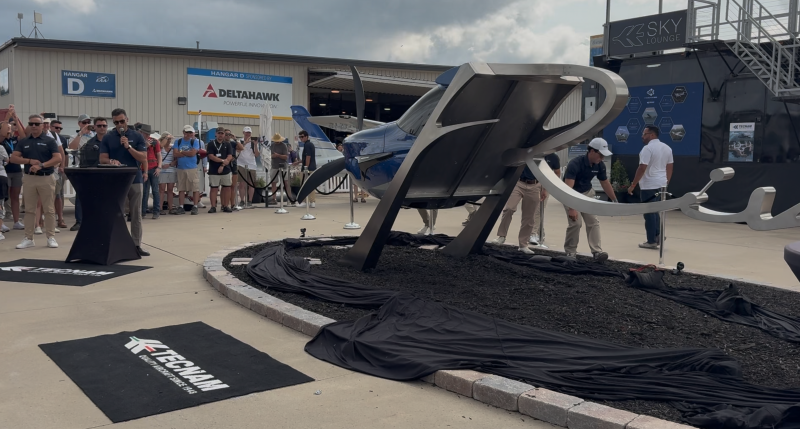
Tecnam Aircraft used the opening days of EAA AirVenture Oshkosh 2026 to tease its next clean-sheet program, the Rivale, a single-engine aircraft positioned squarely at private owner-pilots rather than the flight-training and utility markets where the Italian manufacturer has built much of its reputation. The reveal itself was intentionally incomplete—company officials pulled back a black drape to expose only the forward section of the airframe alongside the Rivale name, with Tecnam promising additional details in the days ahead rather than a full specification sheet at the moment of unveiling. That staged rollout, paired with language describing the program as ushering in "a new era of personal flying," signals a marketing push aimed at generating sustained attention throughout the show rather than a one-time announcement, a tactic increasingly common among manufacturers competing for visibility amid Oshkosh's crowded slate of new-aircraft debuts.
For working pilots and operators, the Rivale is notable less for its immediate operational impact and more for what it says about Tecnam's strategic direction. The company has historically split its business between primary trainers like the P2008 and P-Mentor and twin-engine utility platforms such as the P2012 Traveller, the latter of which has found traction with regional carriers and cargo operators including feeder work for larger networks. A dedicated personal-ownership single-engine model would mark an expansion into the owner-flown piston market long dominated by Cirrus, Cessna, and Diamond, and it suggests Tecnam sees room to differentiate on price, styling, or mission flexibility. Pilots who fly for training organizations or fractional operations that already operate Tecnam metal will want to watch whether the Rivale shares type-family commonality with existing models, which could ease maintenance and parts-sourcing decisions for flight schools and small fleet operators.
More broadly, the announcement fits into a persistent pattern at Oshkosh and other major airshows where manufacturers use partial reveals and drawn-out disclosure schedules to maximize earned media across a show's duration, a strategy business aviation OEMs have leaned on increasingly as social media amplifies incremental news cycles. It also reflects continued vitality in the piston single-engine personal aircraft segment, an area some observers worried might stagnate amid rising costs of certification, avionics integration, and compliance with evolving noise and emissions expectations in Europe, where Tecnam is based and subject to EASA rules that often anticipate stricter global standards. A new personal aircraft program also arrives at a moment when the general aviation industry is closely watching how manufacturers balance traditional piston propulsion against parallel investment in electric and hybrid-electric aircraft, an area where Tecnam has already flown demonstrator technology through programs like the P-Volt.
Until Tecnam releases full specifications—expected in subsequent announcements—pilots, flight departments, and prospective buyers cannot yet assess performance figures, useful load, avionics suite, or certification basis, all of which will determine whether the Rivale competes directly with existing four-seat piston singles or occupies a different niche such as a two-seat sport or high-performance cross-country configuration. Fleet planners and flight training organizations evaluating future aircraft acquisitions should treat this as an early signal to monitor rather than an actionable data point, with more substantive analysis likely once Tecnam discloses engine choice, projected speeds, and target price point in the coming days of the show.








 Read original article