Beta CEO: Autonomous Military eVTOL Launch A 'Smart Tactical Move'
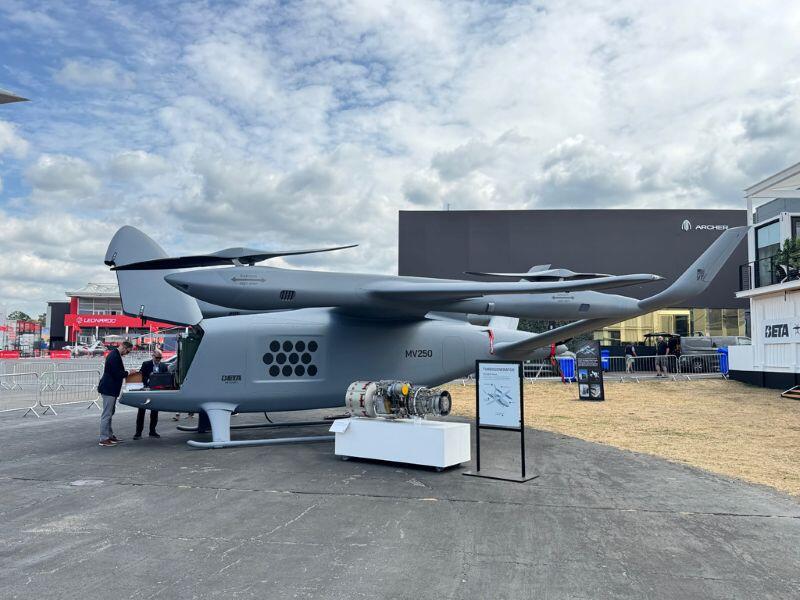
Beta Technologies' announcement of the MV250—an autonomous, military-oriented derivative of its Alia A250 eVTOL—marks a strategic pivot that CEO Kyle Clark frames not as a distraction from civil certification but as an accelerant to it. Unveiled at Farnborough, the MV250 leverages the same H500 hybrid-electric propulsion system already logging over 80,000 hours across Beta's aircraft family, including the passenger-configured A250 and its fixed-wing CX300 sibling. Clark's central argument is that military flight hours, conducted under Public Aircraft Operations authority and military flight release rather than standard FAA processes, generate real-world reliability and safety data that feed directly into the civil certification effort—effectively letting the Pentagon subsidize and de-risk a process that would otherwise be funded entirely through venture capital and slow FAA type-certification testing.
For working pilots and operators watching the advanced air mobility space, this development illustrates a maturing playbook among eVTOL developers facing capital constraints and prolonged certification timelines. Joby, Archer, and others have similarly courted defense dollars (Joby with Agility Prime, Archer with military variants) as a bridge to revenue while civil markets remain years from scaled commercial operations. Beta's disclosure that a NATO exercise in Sweden cost just $330 in fuel for an entire event, and that 270 sorties at Eglin AFB achieved 100% dispatch reliability, speaks directly to the operational economics that will eventually matter to commercial operators, cargo carriers, and air-taxi networks. Dispatch reliability and cost-per-flight-hour are the metrics that determine whether eVTOL fleets can be integrated into scheduled operations, and military validation under demanding, austere conditions provides a credible proving ground that translates into investor and regulator confidence.
The choice of Sikorsky's Matrix autonomy suite for the MV250, while retaining Near Earth Autonomy for civil applications, underscores an important distinction pilots should note: autonomy requirements diverge sharply between military and civil use cases. Matrix is optimized for GPS-denied, lost-link, off-airport operations—scenarios relevant to contested logistics and casualty evacuation—while civil autonomous cargo or passenger operations will require robust ATC integration and detect-and-avoid capability against both cooperative and non-cooperative traffic. This "autonomy agnostic" approach signals that Beta, and likely other eVTOL manufacturers, will need multiple autonomy stacks tailored to distinct regulatory and operational environments rather than a single universal solution—a reality that has implications for pilots who may eventually transition into remote supervisory or fleet-monitoring roles rather than traditional stick-and-rudder positions.
Manufacturing scalability claims also merit attention from an industry-trends perspective. Beta's shift from a bonded, fastener-free fuselage requiring "a number of hours to build" versus six weeks for earlier iterations speaks to the broader push across the eVTOL sector to solve production-rate bottlenecks before certification is even finalized. This mirrors lessons from both legacy aerospace manufacturing and automotive-style production philosophies now being imported into advanced air mobility. For operators and fleet planners, the ability to rapidly scale production once orders arrive—whether military or civil—will be as consequential as certification itself in determining which eVTOL programs achieve commercial viability. Beta's dual-track strategy, using defense contracts to fund maturation while keeping its civil CX300 and A250 programs on parallel, FAA-focused timelines, reflects a broader industry recognition that near-term revenue and long-term certification goals are no longer separable pursuits but mutually reinforcing ones.








 Read original article