Bye Aerospace Completes eFlyer 2 Prototype
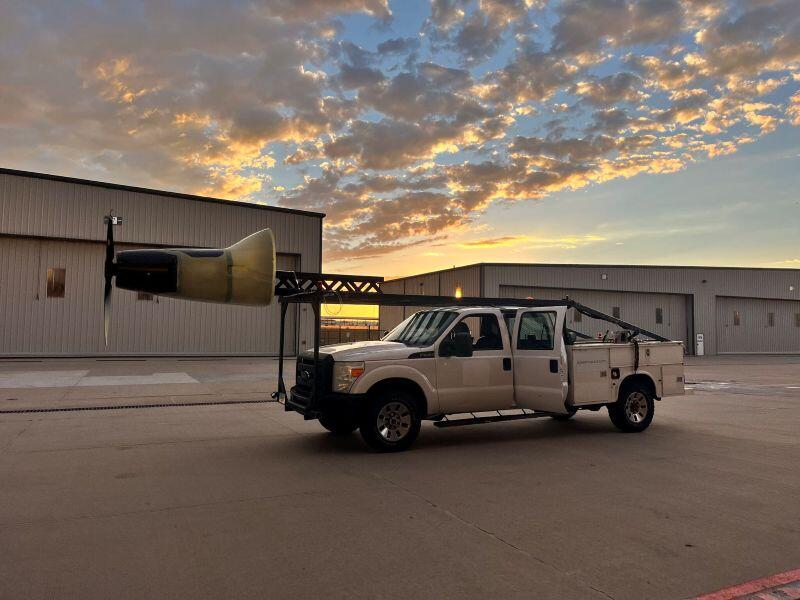
Bye Aerospace has completed assembly of its first eFlyer 2 prototype, reaching this milestone the day before EAA AirVenture Oshkosh 2026, where the company has used the venue to showcase progress on its all-electric two-seat trainer program. The completed airframe now moves into final systems checks ahead of a flight-test campaign, marking a significant inflection point for a program that has spent years in development while competing against a shifting timeline of electric aircraft certification efforts across the industry. Notably, Bye Aerospace validated its propulsion system using a truck-mounted ground test rig internally nicknamed "the Beast," an approach that allows engineers to exercise the electric motor, battery pack, and controller through realistic load profiles at highway speeds before committing to airborne testing—a prudent risk-reduction step given the relative immaturity of certified electric propulsion systems in this weight class.
For working pilots and flight training operators, the eFlyer 2's progress matters because it represents one of the more advanced attempts to bring a purpose-built electric trainer to market under FAA Part 23 certification. Flight schools and Part 141 academies have watched electric trainer programs closely as a potential answer to rising avgas costs, maintenance-intensive piston engines, and mounting pressure from regulators and communities over training-aircraft noise and emissions. An electric two-seat trainer promises dramatically lower operating costs per flight hour, simplified powerplant maintenance without oil changes or TBO overhauls, and quieter operations that could ease noise complaints near busy training airports. However, the practical realities of battery energy density remain a limiting factor, and operators considering fleet transitions need to weigh reduced range and endurance against the promised savings, particularly for multi-leg training sorties or cross-country syllabus requirements.
The broader significance extends beyond flight training into the wider electric and hybrid-electric aircraft landscape, where numerous well-funded programs—from Pipistrel's Velis Electro (already EASA type-certified) to various eVTOL air taxi developers—are racing toward type certificates in different weight and mission categories. Bye Aerospace's incremental, methodical approach, demonstrated by ground-testing propulsion systems on a mobile rig before first flight, reflects lessons learned industry-wide from earlier electric aircraft programs that encountered battery thermal management issues, certification basis ambiguity, and unexpected weight growth. Successful completion of flight testing and eventual FAA certification would validate the business case for electric trainers in the U.S. market specifically, where certification pathways have moved more cautiously than in Europe.
For business aviation and advanced air mobility stakeholders tracking Bye Aerospace more broadly, the eFlyer 2 serves as a technology and certification pathfinder for the company's larger eFlyer 4 and eFlyer 800 programs, which target four-seat and larger commuter/utility missions respectively. Investors, potential launch customers, and fleet planners will be watching flight-test telemetry closely, since propulsion system performance, battery cycle life, and thermal behavior demonstrated on the eFlyer 2 will directly inform confidence in Bye Aerospace's scaled-up designs. As Oshkosh continues to serve as an industry barometer for electric and hybrid propulsion announcements, this milestone reinforces that the transition toward electrified general aviation, while still incremental and constrained by battery technology, continues to advance methodically rather than stalling out after the initial wave of industry enthusiasm.






 Read original article