Qantas Axing Airbus A380 Flights From Major Airport: Here’s The Final Date
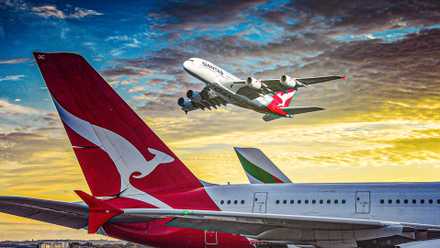
Qantas will retire the Airbus A380 from its Melbourne-Los Angeles route on October 24, 2026, replacing the superjumbo with the Boeing 787-9 Dreamliner from the following day onward. The move leaves Sydney as the only Australian gateway for Qantas A380 service to the US mainland, while Melbourne retains A380 flying exclusively on the Singapore-London Heathrow routing, effectively via SIN. Cirium data shows Qantas has flown 85 A380 departures from Melbourne this year, down from 115 in 2025 and 105 in 2024, though still a fraction of the roughly 700-per-year cadence seen before COVID-19 decimated widebody scheduling in 2020-2022. The airline frames the switch as a cost play: swapping a four-engine, high-capacity aircraft for a twin-engine 787-9 on a route where demand no longer justifies the A380's 485-seat, four-class configuration, while redeploying that capacity to the Kangaroo Route via Singapore.
For working pilots, this is a textbook illustration of network planners quietly right-sizing capacity as fleet economics reassert themselves post-recovery. The A380 remains a spectacular flying machine and a favorite among type-rated crews, but its four-engine fuel burn and heavy maintenance overhead make it increasingly hard to justify on any route where a twin can fill the cabin at similar yields. Qantas retains only ten A380s in its fleet, all identically configured, and the type's long-term future at the airline hinges on route-by-route economics rather than blanket retirement decisions. Crews holding both A380 and 787 type ratings, or transitioning between fleets as Qantas rebalances widebody assignments, will see firsthand how airlines juggle aircraft allocation to match seasonal and market-specific demand rather than defaulting to flagship equipment on flagship routes.
The broader Melbourne data tells a more nuanced story than a simple Qantas retreat. Total A380 departures from the airport are actually projected to hit 1,017 in 2026, the highest since before the pandemic, driven by Emirates and Singapore Airlines maintaining robust A380 schedules to Dubai and Singapore respectively. This underscores that the superjumbo isn't disappearing from Australian skies so much as consolidating among carriers—Emirates and Singapore Airlines in particular—whose hub-and-spoke models and premium long-haul demand still reward the aircraft's scale. Carriers like China Southern, Etihad, Malaysia Airlines, and Qatar Airways have already exited Melbourne A380 service entirely in past years, reflecting a broader industry pattern where the A380 survives primarily at the airlines with the deepest slot constraints at supply-limited hub airports (Heathrow, Dubai, Changi) and the premium cabin demand to fill it.
For flight planning, crew scheduling, and network-strategy professionals, the Qantas decision reinforces a trend playing out across long-haul aviation: the 787, A350, and 777X generation of efficient twins are steadily displacing four-engine widebodies except on the highest-density trunk routes or where slot scarcity makes maximizing seats per movement essential. Business aviation and cargo operators watching secondary effects—Melbourne gate capacity, ground handling equipment sized for A380 turns, and airport infrastructure investments tied to superjumbo operations—should note that even as total A380 movements at MEL climb this year, the mix is shifting toward fewer operators with more concentrated, hub-specific deployment. Pilots and schedulers should expect this pattern to continue as Qantas and peer carriers evaluate each route independently rather than treating the A380 as an automatic assignment for marquee city pairs.








 Read original article