The McDonnell Douglas MD-11 Would've Likely Been Killed If It Weren't For Air Cargo Demand
The MD-11's commercial trajectory illustrates one of the more instructive cautionary tales in widebody manufacturing history, and its survival into the present day owes almost nothing to the passenger mission it was originally designed for. McDonnell Douglas launched the program in 1986 as a stretched, re-engined, re-winged evolution of the DC-10, hoping to leverage a proven trijet platform against the clean-sheet A330/A340 and 777 programs Airbus and Boeing were fielding. The formula—glass cockpit, two-pilot crew, winglets, higher MTOW—looked sound on paper, but the aircraft never hit its advertised range at full payload, burned more fuel than promised, and struggled with aerodynamic drag issues that required years of Performance Improvement Packages to partially correct. Marquee customers like Singapore Airlines walked away before delivery, American Airlines took its 19 airframes with open dissatisfaction, and the program closed out at just over 200 units versus roughly 380 A340s and 1,700-plus 777s. For an aircraft McDonnell Douglas positioned as its ticket back into long-haul relevance, that's a decisive commercial failure.
The deeper lesson for working pilots and fleet planners is timing relative to regulatory and technological inflection points. The MD-11 arrived just as expanded ETOPS rules were dismantling the market rationale for trijets and quads, letting twin-engine widebodies fly the same long-haul missions with two engines to maintain instead of three, lower fuel burn, and simpler dispatch reliability calculus. A trijet's redundancy advantage, which had justified the DC-10 and L-1011 generation, became a cost liability almost overnight. Pilots who flew the MD-11 in passenger service often praised its handling and the reduced crew workload from the two-person glass cockpit, but the aircraft's pitch sensitivity at certain CG/altitude combinations became a known training and safety discussion point, and several high-profile hull losses in the 1990s and 2000s further eroded confidence. Airlines that had signed up in the late 1980s found themselves retiring MD-11s well ahead of typical widebody life cycles, a stark contrast to the DC-10 airframes it was meant to replace.
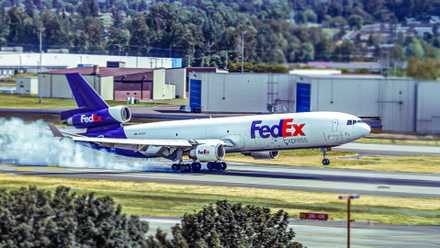
What kept the type alive—and what makes it directly relevant to current cargo and freight operators—is precisely the payload-over-range tradeoff that killed it in passenger service. FedEx, UPS, and Lufthansa Cargo found that an aircraft with a large main-deck volume, robust structure, and range sufficient for most cargo lane structures was extremely well suited to freighter conversion, especially once passenger operators began divesting airframes at attractive prices in the 1990s and 2000s. Cargo operators don't need to fill every seat and every fuel tank simultaneously the way passenger carriers do, so the MD-11's payload-range compromise mattered far less. That secondary market extended the type's production run, since McDonnell Douglas and later Boeing continued building or converting MD-11Fs even as passenger orders dried up, and it explains why the MD-11 remained a fixture of nightly freight networks for three decades after its commercial passenger failure.
For pilots and operators today, the MD-11 story underscores several enduring dynamics still shaping fleet decisions: regulatory shifts like ETOPS can reshape aircraft demand faster than manufacturers can respond with derivative designs; three- and four-engine architectures now survive almost exclusively in freighter, VIP, or niche long-range roles where payload flexibility outweighs pure trip-cost efficiency; and cargo demand can function as a lifeline for airframes that passenger markets reject, a pattern also visible in 747-8F production runs and A300/767 freighter conversions. As FedEx and other operators now begin transitioning away from their remaining MD-11 fleets toward 777Fs, the type's retirement will close out one of the last widebody trijet operations in commercial service, marking a final chapter for an aircraft that never succeeded at its intended mission but found a durable, if unglamorous, second life hauling freight.







 Read original article