Why The Most Advanced Aircraft Are Often The 1st To Become Obsolete
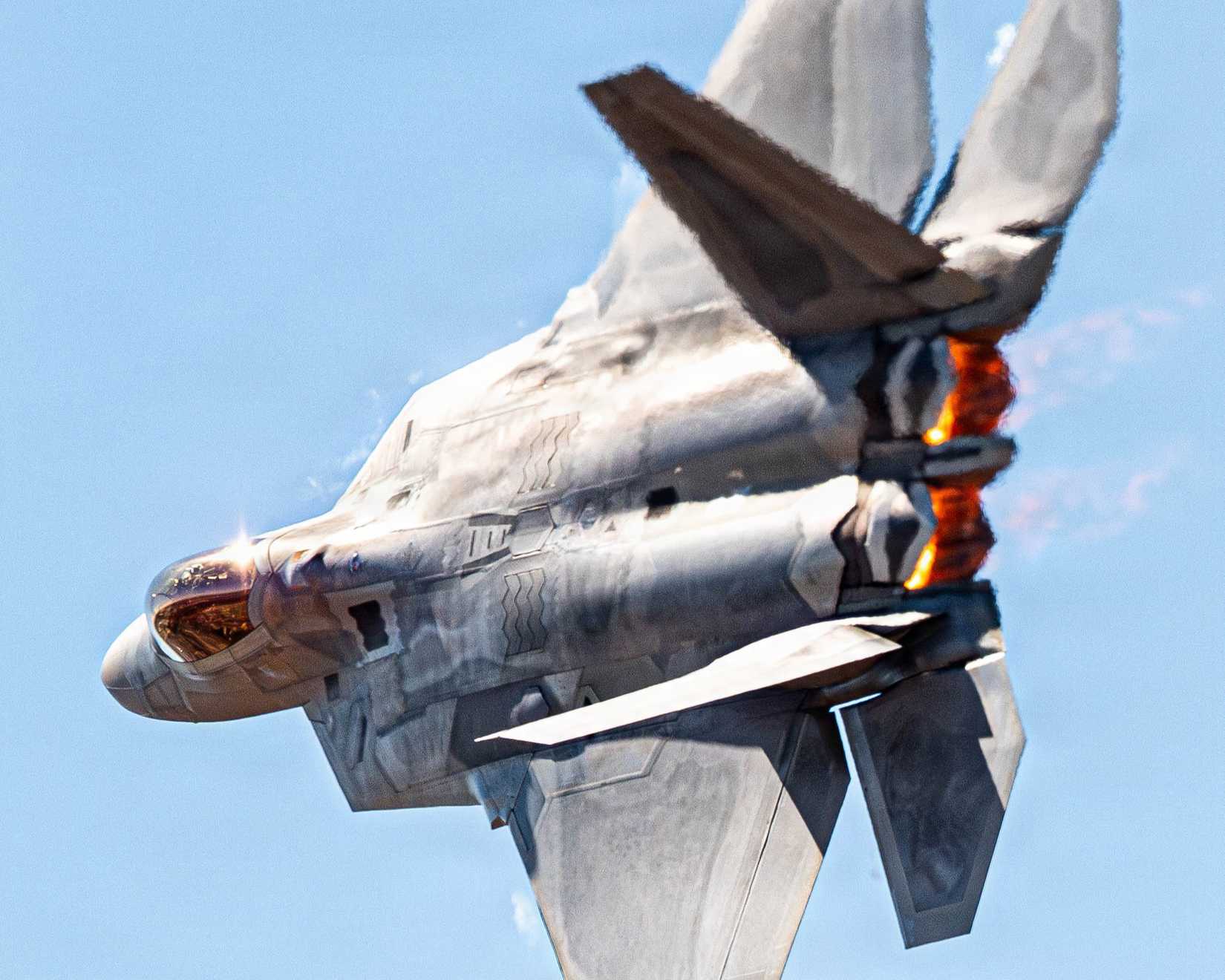
The lifecycle paradox of peak-performance military aircraft reveals a structural tension in aerospace procurement that extends far beyond combat aviation: the most capable platforms are frequently the most expendable once a superior successor emerges. The F-22 Raptor and B-2 Spirit represent this dynamic with clarity. Both aircraft were designed to occupy an unchallenged niche — air dominance and stealthy strategic strike, respectively — and both were produced in small numbers at enormous per-unit cost precisely because that niche was narrow. The F-22's production run stopped at 187 airframes, while only 20 B-2s were built. Those constrained inventories reflect the same procurement logic that now accelerates their obsolescence: when a platform is purchased in quantities too small to fully replace a legacy fleet, the legacy fleet survives, and the expensive new aircraft occupies a specialty role rather than becoming the backbone of operations. The F-22 never displaced the F-15 as the Air Force's primary strike workhorse, and the B-2 never supplanted the B-52 or B-1B as the primary bomb truck, leaving both advanced aircraft stranded between being indispensable and being irreplaceable.
The mechanism driving early obsolescence is not technological failure but economic logic. As the article identifies, a cutting-edge aircraft remains justifiable in procurement terms only so long as no superior alternative exists. The moment the Boeing F-47 and Northrop Grumman B-21 Raider mature into viable operational programs, the F-22 and B-2 transform overnight from premium assets into expensive legacy liabilities that compete with next-generation procurement budgets. This is not a gradual erosion — it is a threshold event. The F-22 may still outperform the Chinese J-20 or Russian Su-57 in certain engagement envelopes, but that comparison becomes operationally irrelevant if the F-47 decisively outperforms the F-22 across all mission sets. The same logic applied historically when the SR-71 Blackbird, a marvel of 1960s engineering capable of Mach 3+ cruise at 80,000 feet, was retired while the subsonic U-2 — slower, less exotic, and operationally cheaper — continued flying. Utility and sustainability outlasted raw performance. The B-52's projected service life extending to approximately 2060, alongside the B-21, underscores this principle: a proven, adaptable, high-payload airframe funded at scale can remain operationally relevant long after technically superior but economically fragile platforms have been retired.
For aviation operators outside the military sphere, the dynamics described here mirror fleet management decisions made daily in commercial and business aviation. Airlines and fractional operators routinely confront the same core tension: a newer aircraft may offer dramatically superior economics or capabilities, but the capital cost of transition, the residual value of existing airframes, and the production ramp of the new type all govern when a transition becomes rational rather than merely desirable. The Boeing 747-8 faced accelerating obsolescence not because it was a poor aircraft but because twin-engine widebodies matured to the point where four-engine economics became indefensible. Similarly, Part 91 and 135 operators evaluating whether to upgrade older Gulfstream or Bombardier cabins must weigh the cost of a transition against the actual operational gap between platforms. The military's decision to pursue mid-life upgrades for the F-22 into the 2040s while simultaneously doubling F-15EX procurement to 267 airframes reflects the same calculation a charter operator might make when refurbishing a capable mid-size jet rather than committing to a new-type transition before the replacement program matures.
The broader trend this article illuminates is the increasing importance of modularity, adaptability, and interoperability in defining platform longevity. The F-47 is described as being designed from the outset as a networked command center integrated with Collaborative Combat Aircraft drones, rather than a standalone air superiority fighter. This architectural philosophy — building platforms to function as nodes in a larger system rather than standalone performers — is reshaping procurement thinking across aviation sectors. In commercial aviation, this manifests as increased emphasis on avionics standardization, datalink integration, and airspace system compatibility over raw performance metrics. In business aviation, operators and flight departments evaluating next-generation aircraft increasingly weigh connectivity infrastructure, RNP and RNAV capability, and integration with flight operations software alongside range and cabin specifications. The era of evaluating an aircraft purely on its intrinsic performance envelope, divorced from its role in a broader operational ecosystem, is ending in both military and civil aviation. Platform longevity will increasingly belong to aircraft designed to evolve within a system, not to those designed to dominate it in isolation.








 Read original article