How United Is Quietly Rebuilding Washington Dulles Into Its Ultimate Hub
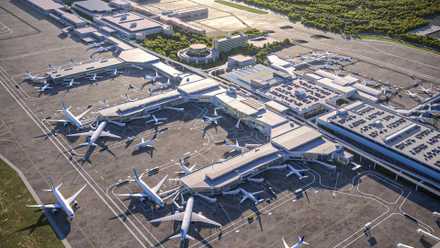
Washington Dulles International Airport is entering the largest infrastructure transformation in its history, catalyzed by an unusual alliance between United Airlines CEO Scott Kirby and President Trump. The headline figures are substantial: a $22.5 billion program encompassing more than 5 million square feet of new or renovated space, a complete replacement of the aging Concourses C and D, a 32,000-space close-in parking garage, and the eventual retirement of Dulles' iconic but operationally limiting mobile lounge fleet. While Trump's Oval Office presentation—complete with laser pointer and renderings—created the impression of a White House-originated mega-project, the reality is more nuanced. The plan is rooted in the Metropolitan Washington Airports Authority's Master Plan, approved by its board in July 2025, with roughly $7 billion already allocated and the first phase of a new Concourse E already under construction ahead of a fall opening. What Trump has genuinely added is political acceleration—compressing a multi-decade planning horizon into a program with executive urgency behind it.
For working pilots and aviation operators, this matters well beyond the optics of a presidential photo op. Concourses C and D have long been a case study in operational friction: 50 jetbridge gates served by an outdated mobile-lounge system requiring 630 trips a day just to move passengers between the terminal and aircraft. That model creates taxi and ramp inefficiencies, complicates gate turns, and adds unpredictable variability to connection times—all factors that ripple into scheduling reliability, crew duty planning, and on-time performance metrics that airlines and pilot groups track closely. Replacing that system with AeroTrain connections, walking tunnels, and modernized concourses capable of handling larger aircraft directly addresses gate capacity and turnaround constraints that have shaped United's Dulles operation for years. A more efficient international arrivals and Customs facility, expanding from today's 2,400-passenger hourly capacity, also has direct implications for widebody scheduling banks, since Dulles functions as United's primary Atlantic and secondary Pacific gateway.
The strategic significance for United is arguably more important than the construction numbers themselves. United already carries two-thirds of Dulles' 29 million annual passengers and controls the C/D gate complex outright, giving it a degree of hub dominance rare among U.S. legacy carriers at a major international gateway. A ground-up rebuild designed in direct consultation with United—down to a "major new Polaris Lounge" and expanded club space—effectively lets the airline architect a hub around its own long-term fleet, network, and premium-product strategy rather than adapting to inherited infrastructure. This is a notable departure from how most airport capital programs unfold, where airlines compete for incremental gate and lounge concessions within a facility largely shaped by a public authority's own planning priorities. Kirby's success in securing direct presidential engagement—following a broader pattern of aviation executives cultivating access in Washington—illustrates how infrastructure funding and prioritization decisions increasingly hinge on political relationships as much as traditional FAA and DOT capital planning processes.
Broader industry trends reinforce why Dulles' rebuild resonates across commercial and business aviation. U.S. hub airports, from Newark to LaGuardia to now Dulles, are confronting a common reality: legacy terminal and ramp infrastructure designed for 1960s-80s traffic volumes and aircraft types is straining under record passenger growth, larger widebody gauges, and higher connection-bank complexity. Programs that modernize Customs processing, parking, and ground transportation also matter to charter, fractional, and business jet operators who interface with these hubs for passenger connections and crew logistics, even if their own operations run through separate FBO infrastructure. Dulles' transformation, following similar mega-projects at LaGuardia, JFK, and Salt Lake City, signals that the current capital cycle in U.S. airport development is being driven less by pure aviation-demand forecasting and more by a mix of carrier lobbying, political timelines, and hub-dominance strategy—a dynamic pilots and operators should watch closely, since it will shape gate availability, taxi routings, and operational tempo at one of the nation's busiest international gateways for the next decade.







 Read original article