Flight Review: Turkmenistan Airlines 777-200LR & 777-300ER Business Class From London To Bangkok
Turkmenistan Airlines occupies a peculiar niche in the international airline landscape: a state-owned carrier that operates modern 777-200LR and 777-300ER widebodies on long-haul routes to major hubs like London, Frankfurt, Beijing, and Dubai, yet remains almost entirely outside the conventional distribution ecosystem that pilots and industry professionals take for granted. No GDS listings on mainstream OTAs, no online check-in, mandatory desk check-in only, no inflight alcohol, and an explicit no-photography policy in the cabin all point to an operator still functioning under Soviet-era state airline norms rather than modern IATA distribution and customer-experience standards. For an outside observer, particularly one with an operational eye, this is a useful case study in how much of the world's airline capacity still exists outside the digital booking infrastructure that Western and Gulf carriers have standardized.
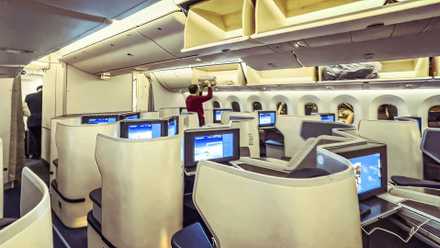
The equipment details are notable in their own right. Turkmenistan Airlines' 777-200LR fleet (only two aircraft) and its 777-300ERs represent a disproportionately large widebody investment for a country of roughly six million people, reflecting the geopolitical and economic priorities of a resource-rich, isolated state rather than pure route economics. A 2-3-2 business class configuration on the -200LR, without suites or doors, is now a full generation behind the staggered, privacy-shelled business products rolling out at Emirates, Qatar, Etihad, and even some U.S. carriers on comparable routes. Yet the review notes healthy load factors and a full business cabin, suggesting the airline is quietly capturing price-sensitive long-haul connecting traffic — in this case London to Bangkok via Ashgabat — undercutting competitors like Etihad and Emirates on fare despite comparable total journey times. This pricing dynamic is a reminder that fifth-freedom and hub-connecting competition from lesser-known state carriers can still meaningfully affect yield and market share on trunk long-haul corridors, a dynamic worth watching for network planners and revenue management teams at legacy international carriers.
For working pilots, particularly those flying for legacy international or Gulf carriers, this kind of review is a useful intelligence data point rather than a direct operational one. It illustrates how competitors with opaque distribution, lower transparency, and non-standard passenger experience policies (no alcohol, no photography, no online check-in) can still fill widebody cabins on comparably priced long-haul, one-stop itineraries. It also underscores the diversity of operating environments and regulatory/cultural constraints that exist globally — useful context for pilots who may fly into Ashgabat or similar restricted, state-controlled airspace and airport environments, where security culture and passenger-facing rules diverge sharply from Western norms. Crews operating international long-haul routes increasingly need awareness of these operational and cultural variances, from ramp and terminal procedures to onboard service policy, especially as airlines pursue new city pairs and codeshare or interline arrangements with carriers outside the traditional alliance structures.
More broadly, this review fits a growing media trend of aviation enthusiasts and journalists documenting "hard to book" or opaque state carriers — Turkmenistan Airlines joins the ranks of North Korea's Air Koryo, Iran Air, and others as a subject of fascination precisely because it resists conventional analysis. For aviation professionals, the real takeaway is less about the specific hard product and more about market structure: state carriers with non-market-driven capacity decisions, minimal digital distribution, and geopolitical rather than purely commercial route logic remain a persistent, if under-analyzed, segment of global widebody capacity. As commercial aviation continues to consolidate around alliance networks, NDC distribution, and increasingly homogenized business-class hard products, outliers like Turkmenistan Airlines are a reminder that a meaningful share of global long-haul capacity still operates by very different rules — a relevant consideration for anyone analyzing competitive capacity, route economics, or crew planning on Europe-Asia and connecting Central Asian corridors.







 Read original article